

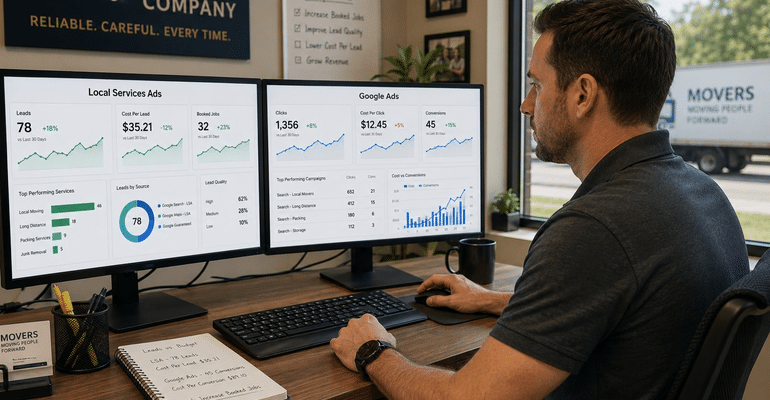
For most moving companies just starting with paid advertising, Local Services Ads should come first. They’re faster to set up, charge per lead instead of per click, and include the Google Guaranteed badge that helps convert moving leads. Google Ads comes second once LSAs are running effectively.
What each platform actually is and how they’re different
Many movers compare LSAs and Google Ads as if they’re the same thing. They’re not. Understanding the difference makes the decision much easier.
Local Services Ads (LSAs)
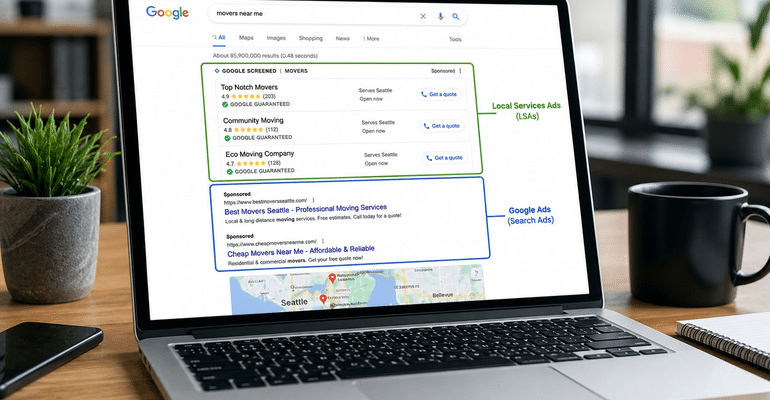
Local Services Ads appear at the very top of Google search results, above traditional ads and organic listings. They display your company name, review rating, review count, business hours, and a click-to-call button.
LSAs also include the Google Guaranteed badge, which requires business verification, licensing checks, insurance verification, and background screening.
Unlike Google Ads, LSAs charge per lead rather than per click. You only pay when a potential customer contacts you through the listing. Moving companies are an eligible category for LSAs throughout much of the United States.
Google Ads (Search)
Google Ads are the text ads that appear beneath LSAs and above organic search results. Instead of paying per lead, you pay every time someone clicks your ad. Whether that visitor becomes a customer or not, the click still costs money.
Google Ads require:
- Keyword targeting
- Ad copy creation
- Landing pages
- Bid management
- Ongoing optimization
The upside is control. You can target specific services, locations, devices, audiences, and search terms. That flexibility gives Google Ads a much higher ceiling for scaling.
Where each appears on the page
When someone searches “movers near me,” the typical results page looks like this:
- Local Services Ads
- Google Ads
- Google Local Pack
- Organic search results
A moving company running both LSAs and Google Ads can appear twice on page one. That’s usually the long-term goal. The question isn’t which platform is better forever. Which one should come first?
The five differences that actually matter for moving companies
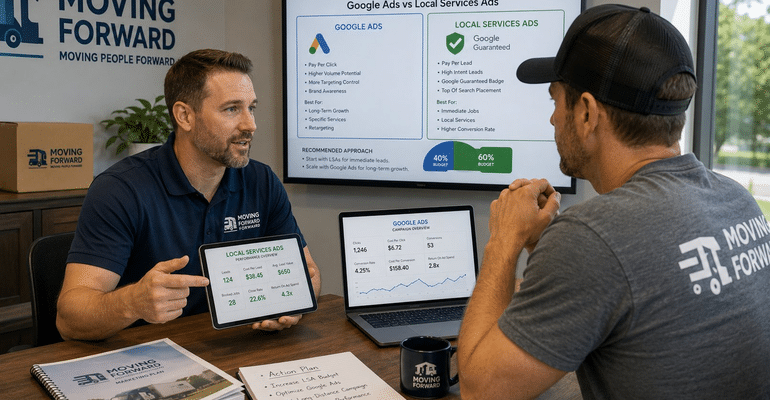
1. Cost model: Pay-Per-Lead vs Pay-Per-Click
This is often the biggest factor for new advertisers. LSAs charge per lead. A customer must call or message you before you pay.
Google Ads charges per click. Some clicks come from serious buyers. Others come from researchers, competitors, or people comparing multiple companies. Moving-related keywords often cost between $8 and $30+ per click. LSA leads generally cost between $20 and $80, depending on market conditions. For movers with limited budgets, the LSA model typically produces less wasted spend.
2. Setup time and complexity
LSAs require verification.
You’ll need to submit:
- Business licensing
- Insurance information
- Background checks
- Business verification documents
This process can take one to four weeks.
Google Ads can launch much faster. In many cases, campaigns can be live the same day. The tradeoff is ongoing management. Google Ads require constant attention, while LSAs usually need far less maintenance once active.
3. Trust signal: The Google Guaranteed Badge
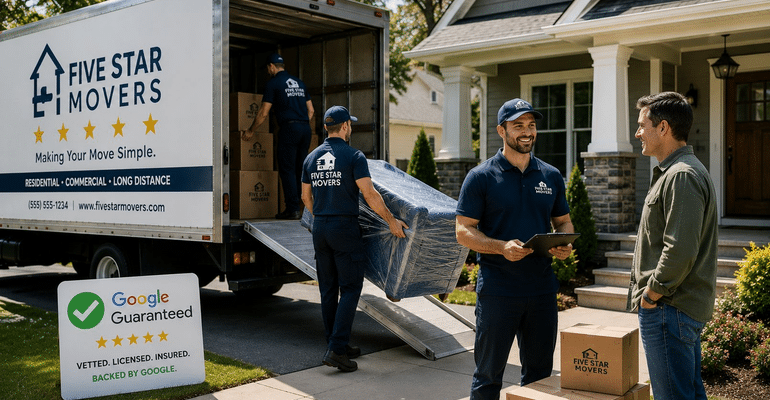
Trust is one of the biggest obstacles moving companies face. Customers are allowing strangers into their homes and trusting them with valuable belongings. The Google Guaranteed badge immediately reduces uncertainty. Searchers know Google has verified the company before allowing it to participate.
Traditional Google Ads offer no equivalent trust signal. The burden falls on your landing page, reviews, and branding. For many local movers, the badge alone can significantly improve conversion rates.
4. Control over targeting
This is where Google Ads wins.
Google Ads allows you to target:
- Specific keywords
- Service types
- Device types
- Geographic areas
- Times of day
- Audience segments
LSAs provide far less control. You choose service areas and budgets, but Google determines which searches trigger your listing. If you’re targeting commercial relocations, long-distance moves, storage services, or specialty moving jobs, Google Ads provides much greater precision.
5. What happens after the click
LSAs send prospects directly into Google’s lead process.
Customers can:
- Call your business
- Send a message
- View your profile
There is no landing page involved.
Google Ads sends visitors to your website. This gives you opportunities to:
- Explain your services
- Capture form submissions
- Build trust
- Track conversions
- Retarget visitors later
For long-distance movers with longer sales cycles, this additional flexibility is extremely valuable.
Which should you run first? The decision framework
Most moving companies don’t need a complicated answer. They simply need to identify which category they fit into.
Run LSAs first if:
- You’re new to paid advertising
- Your budget is under $1,500 per month
- You focus primarily on local residential moves
- You want leads within a few weeks
- You don’t have a dedicated landing page
- Your Google Business Profile has at least 10 reviews
LSAs are generally the easiest and lowest-risk way to begin generating paid leads.
Run Google Ads first if:
- You already have LSAs running
- You focus on long-distance or interstate moves
- You want keyword-level targeting
- You have a strong landing page
- You have a budget for management and optimization
- Your market has affordable click costs
Google Ads becomes particularly valuable when you want to target specific services that LSAs don’t prioritize. For setup guidance, see how to launch your first Google Ads campaign.
Run both simultaneously if:
- Your advertising budget exceeds $4,000 per month
- You want maximum page-one visibility
- You’re in a highly competitive market
- You can track ROI separately for each platform
One warning: many moving companies try to split a small budget between LSAs and Google Ads. This usually results in both campaigns underperforming. It’s better to run one platform properly than two platforms poorly.
What we’ve seen work for moving companies
At Movers Development, we’ve found that most moving companies get the best results by starting with LSAs and adding Google Ads later. LSAs typically generate leads faster, require less ongoing management, and benefit from the trust boost provided by the Google Guaranteed badge.
Google Ads usually become more effective once a mover has a strong website, dedicated landing pages, and a clear understanding of which services generate the highest revenue. That’s especially true for companies targeting long-distance, commercial, or specialty moving services.
The highest-performing movers don’t treat LSAs and Google Ads as competitors. They use LSAs to capture customers ready to call today and Google Ads to reach prospects earlier in the research process. In our experience, that combination creates a more consistent lead flow and better long-term growth than relying on either platform alone.
Cost comparison: What moving companies actually pay
One of the most common questions is how much each platform costs.
LSA costs for moving companies
Typical ranges include:
- Cost per lead: $20–$80
- Competitive metros: $80–$150+
- Recommended monthly budget: $500–$1,000
The major advantage is that you only pay when someone contacts you.
Google Ads costs for moving companies
Typical ranges include:
- Local moving keywords: $8–$25 CPC
- Long-distance keywords: $15–$35 CPC
- Recommended monthly budget: $1,000–$1,500 minimum
Google Ads campaigns also experience a learning period. During this stage, some spending inevitably goes toward clicks that don’t convert. Many movers see 20–40% of early ad spend go toward non-converting traffic before campaigns become fully optimized.
For example:
- A moving company spending $1,000 on Google Ads may receive 40–80 clicks.
- A moving company spending $1,000 on LSAs may receive 12–30 direct leads.
- At lower budgets, the lead-quality advantage generally favors LSAs.
- As budgets increase and campaigns mature, Google Ads often becomes the stronger growth channel.
The one thing most moving companies get wrong
Most movers treat LSAs and Google Ads as competitors. They’re actually complementary channels. LSAs primarily capture bottom-of-funnel prospects. These are people ready to call today. Google Ads often capture middle-of-funnel prospects. These searchers are researching options, comparing companies, and gathering information before making a decision.
If you only run LSAs, you miss many future customers who haven’t reached the call stage yet. If you only run Google Ads, you miss the highest-visibility position on the page and the trust benefits of Google Guaranteed.
The best sequence for most movers is simple:
- Launch LSAs.
- Build reviews and generate initial leads.
- Add Google Ads once LSAs are producing consistently.
- Use Google Ads to target specific services and markets.
Final verdict
For most moving companies, the answer is straightforward: start with LSAs, then expand into Google Ads.
LSAs provide a faster path to qualified leads, require less management, and offer the Google Guaranteed trust signal that many customers look for before contacting a mover. Google Ads becomes valuable once you’re ready to scale, target specific services, and capture searchers earlier in the buying process.
If you’re preparing to launch paid advertising, don’t spend months debating the choice. Start with the platform that matches your budget and goals today, then build from there. Before launching, review how movers can benefit from Google Ads latest features to understand the newest opportunities available within the platform.